
Last year, about this time, I went on a much-needed retreat. It had been over two years since I was able to spend time at this particular retreat center: a beloved place where I have always felt connected and held.
The center is surrounded by forest. For the first seven years of my going there, I had never set foot inside its borders or even been curious about what might be there. In the eighth year, I ventured inside on each of the two retreats that bookended my sabbatical. Those few hours spent among the trees were among the most significant out of all that time of rest and renewal.
When the pandemic prevented me returning to this place, it was the trees that I longed for, and the gentle stream that winds through them.
I spoke with a friend before I went on this retreat, sharing my heart’s desires, my doubts, my brokenness. I asked for my friend’s wisdom, knowing they have walked their own paths of death and rebirth, letting go and starting over again. My friend offered gentle suggestions for my consideration, including this: “You need to Rest, full stop. Again, your body is showing clear signs of burnout. It is okay to rest and you must. […] Find a Mother Tree in the forest, ask her where she is, and curl up at her feet—metaphorically or physically. […] If the forest resonates with you, let it nurture and care for you.”
The retreat included two nights with one full day in between. I made plans to go into the woods on that middle day after lunch, to give myself as much time there as possible. Unlike the previous two walks in the woods, I packed a bag this time. It was hot, and I wanted to carry water, and a snack in case I got hungry, and my phone in case of emergencies, and a blanket in case I wanted to literally lie down on the forest floor beneath the trees.
In my typical fashion, I took my friend’s gentle guidance as an assignment. I set off into the woods focused on finding a Mother Tree. I have learned enough about my own perfectionism to be mindful about telling myself I was not looking for the Mother Tree, simply a Mother Tree. There would be many possible trees I could rest beneath, and I did not have to make the exact right choice.
Also in my typical fashion, I wanted to go back to the places in the woods that had spoken to me before, so without listening for any internal guidance, I started off on the familiar wide trail, knowing at some point I would need to depart from it in order to follow the path of the stream instead.
The bag I had packed was awkwardly shaped, and the straps were uncomfortable on my shoulders. I quickly removed my sandals, which then meant yet more for me to carry. The mud felt lovely and cool on my bare feet. How long had it been, I wondered, since I walked barefoot on the ground. Years, I am sure. Long before the pandemic. Probably it had been the last time I was in those woods.
The trail opened onto a field, as I knew it would. I trod carefully, mindfully, through the mown grass, not wanting to step on the toads I could hear chirping out of sight. As I crossed back into the woods, I was disappointed to see that there was no water flowing in the stream. I comforted myself that it had not rained recently, and there would surely be more water further down.
As I walked, I paused to admire many large and beautiful trees, even placing my hands on the bark of a few, but none were the kind of Mother Tree I was looking for. I reached a point where the trail led up over a ridge, away from the stream, and I turned off to wade through the thick Asian grasses that have taken over the forest floor.
A little ways away, I saw her. A huge Mother Tree, with two massive trunks reaching high up into the canopy. The next moment, I noticed that something was wrong. A deep crevice split the side of the tree that was facing me, almost down to the ground. As I approached, the truth became clear: the Mother Tree was burned out, completely hollow at the core. She must have been struck by lightning, which kindled the flames that miraculously did not spread to the surrounding trees. High above my head, many of her branches were still bearing leaves, but the tree was clearly dying. All of her energy was being spent keeping those last few leaves alive.
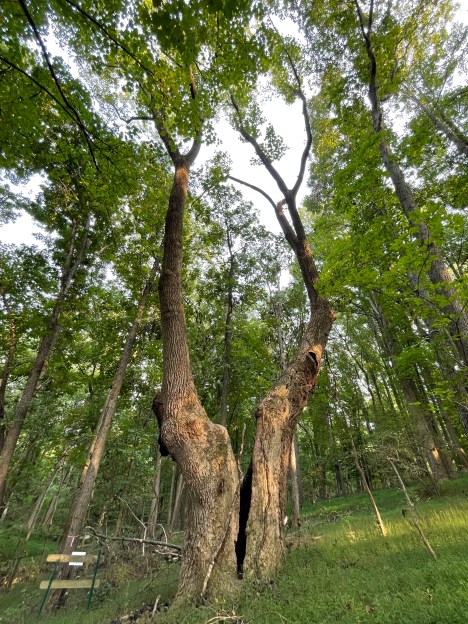
I was both fascinated and repulsed. Was this the Mother Tree that was to comfort me? The one where I would find rest and nourishment? I peered into her hollow center, which was large enough that I could easily have laid down inside. I briefly considered climbing in, but I was worried I would not be able to get back out. I could see bright green leaves through the holes that had been burned all the way through in each of her trunks. There was a smell of death, of decay, and of damp, charred wood.
I did not want to stay there, but I had an assignment. This was quite clearly a Mother Tree, and I did not see any others nearby. So I walked around to the far side of the tree, where the surface of the trunk was still intact. I spread my blanket next to the roots and sat down.
As I sat, I discovered that my skirt was covered in sticky seeds from a particular variety of those invasive grasses that surrounded the Mother Tree. Now my blanket was covered in them, too, and also the hairs on my legs. I tried to settle down into some kind of restful state, but my annoyance at the seeds (and the thought of how much work they would be to unstick) was too distracting. In irritation, I pulled out my phone to see if I could at least identify the plant that was bothering me.
On the screen was a notification from the Night Sky app that I had downloaded the night before. It told me that the Moon was rising, right then. I opened the app and saw that I had sat down facing directly toward the rising Moon. I thought this must be some kind of sign that I was in the right place, so I put the phone away and stayed.
But it was all wrong. The ground felt lumpy and uncomfortable beneath me. I couldn’t find a good place to lean against the tree. I was sweaty and hot. The mosquitoes came to investigate, followed by a buzzing bee that caused me to flinch and shriek, “Go away!” And I couldn’t escape the smell of decay, even on this side of the tree.
I gave up. There must be another Mother Tree somewhere else in the woods where I could actually rest.
I picked myself up, shook out the blanket and my skirt (in vain), and continued on through the woods. I could see that the stream still had barely any water in it. I thought I could at least find one of the other places that had been special to me in the past, and maybe find some sense of connection there. The grass was thick and deep. I put my sandals back on to try to make walking easier. There were a few more interesting trees along the way, and a boulder where I gratefully rested for a while, but no Mother Tree.
I located the place I had in mind eventually, but it looked completely different: the fallen trees now barren of their bark, the path overgrown. There was just enough water in the stream at that point for me to dip my hands in and splash some over my face and head. It could have been a kind of ritual, but it was mainly to cool me down. Climbing back up the bank, I slipped and fell, then laughed aloud at how absurd the whole adventure had become.
It was growing late. Even at that distance, I could hear the bells of the retreat center tolling the hours and half-hours. I was not going to try to fight my way back along the stream, so I took the path that led up and over the ridge. Eventually, I had to turn off and head downwards again, following some paths that were little more than deer trails.
Shortly before I saw her, I realized that I had come full circle and was back at the burned-out Mother Tree. During the first encounter, I had resisted taking any pictures, because of some rules in my head about not photographing the place where I was supposed to be having a sacred experience. This time, I decided I didn’t care. I took pictures from all different angles: far away and close up, down into the hollow center and up into the branches. In my head, I was already writing an email to my friend: “I found a Mother Tree, but she was literally burned out.” I wanted to be able to show exactly what it looked like.
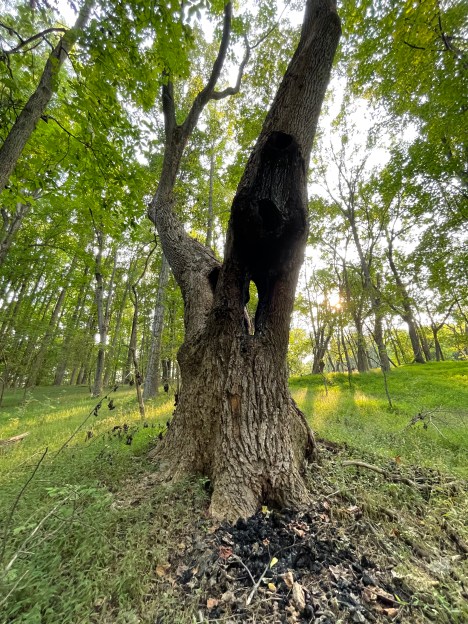
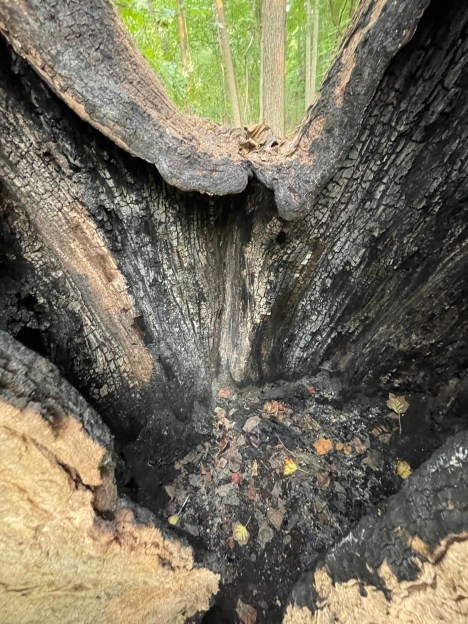
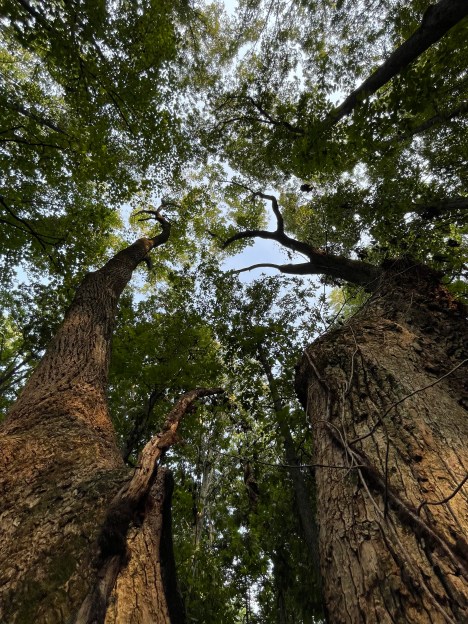
And then I walked back to the center, looking forward to a cold shower and setting down the awkward bag. I took my sandals off again when I reached the first part of the path, to feel that lovely cool mud. I laughed to myself as I realized that the beginning and end had been my favorite parts of the entire exploration: the parts where the trail was wide and clear, and I didn’t have to think about where I was going, and the earth felt pleasant under my bare feet.
After dinner, I journaled about my time in the woods. I considered the possible meanings of the Mother Tree that I had found. Perhaps she was a symbol of how resilient nature is, reminding me that life on this planet will continue in some form, even if human beings do not. Perhaps she was a sign of my own resilience: that I am able to keep bearing leaves despite being hollow at my core. Perhaps the tree was a cautionary tale, a living reflection of my inner state of being. “I am burned out,” I wrote, “and I need to stop trying to force myself to go on. I need to let go of my striving, before I am utterly empty inside. Before I fall over from exhaustion.”
My pen ran out of ink as I was writing those sentences. Another metaphor, like the dry stream.
That night, I went to bed early, inspired by a dove that I had seen settle down to roost on the bare branch of a tree shortly after sunset. I did not even wait for it to get dark.
My plan had been to go into the woods only once. I did not think I had enough time for a second visit, because in my mind, such exploration needed several hours. But the next morning, I kept thinking about the trees. I kept thinking there was more for me out there. I knew I wanted to go back. So I asked for a later time to check out of my room, and it was granted. Two extra hours before I needed to be packed up.
This time, I took almost nothing with me, not even my phone. I removed my sandals as soon as I left the building. I allowed myself to be led in a different direction, towards the closest edge of the woods, where there was no trail entrance. I set down my sandals, took off my hat and sunglasses, and made a pile on the grass, tucking in my face mask and room key last of all. I entered the forest carrying nothing but my clothing. I think that if I had not still been in sight of the retreat center, I would have left that behind as well.
A little way in, a wide path used for horse riding opened up, running to my left and right. But it was rough and rocky on my feet, and it would have kept me along the edge of the woods. Instead, I walked straight ahead, enjoying the softness of the dry brown leaves under foot. I knew that I was crossing onto the neighbor’s land, but that did not matter. The forest knows nothing of property lines. Another path soon became clear, leading me deeper in. I walked it slowly, mindfully, as though it were a labyrinth.
She was right there beside the trail: a Mother Tree with four solid trunks rising up toward the sky, inviting me to climb up in between them.
I did not curl up at her feet. I curled up in her arms.
I will not say much about my visit with this tree, except that I did at last find some Rest. And, for a time, that was enough.
Copyright Diana E. Carroll
September 2021
 Diana Elizabeth Carroll
“What’s important is the journey, not the destination” is a time-honored phrase. I propose a modification: “Sometimes the journey is more important than the destination, and other times the reverse is true. And sometimes both are equally as enlightening.” Thanks for sharing both with us.
LikeLike