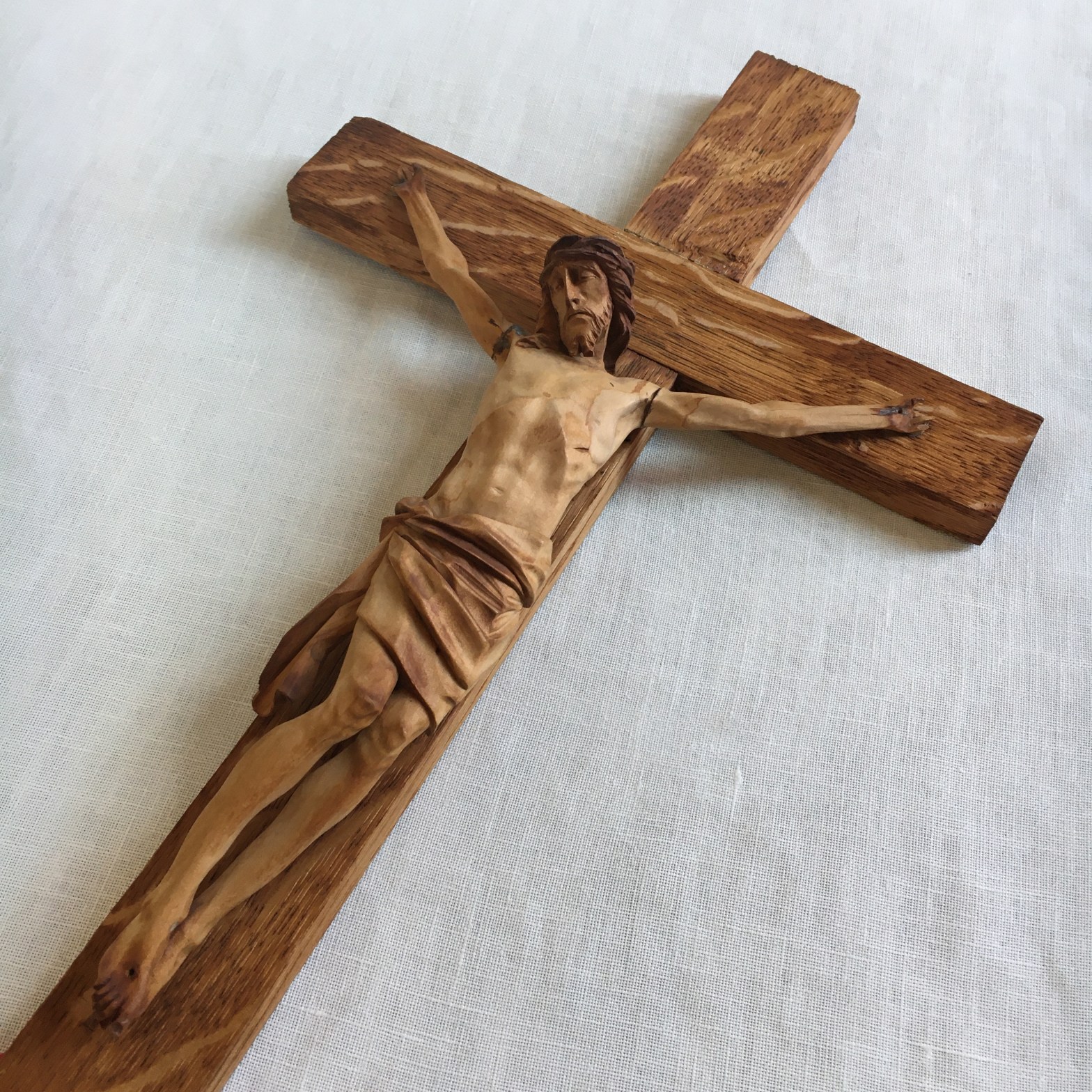
By a perversion of justice he was taken away.
A man, a member of a subjugated people, dies at the hands of the state. A crowd of onlookers watches, helpless to intervene, as he slowly suffocates to death. The officials who kill him believe that they are simply doing their job. His death and its aftermath spark a movement that changes the world.
This is the story of the death of Jesus Christ, which we have just recounted together, as we do on this day each year. It is also the story of countless others around the world and throughout history. In our own day, in our own country, it is the story of George Floyd, whose death at the hands of a Minneapolis police officer last May galvanized global protests, activism, and organizing for racial justice and for changes to our systems of policing and public safety.
The trial of the former police officer who killed George Floyd is in its fifth day today. As I listen to the news accounts, to the audio clips of testimony and legal arguments, I cannot ignore the parallels to Good Friday and to Jesus. Like Jesus, George Floyd did not, at the time of his death, pose a violent threat to anyone, and yet he still died violently. Like Jesus, images of George Floyd and of his death have been painted and drawn and reproduced and shared across every nation on earth. Like Jesus, George Floyd has become emblematic of systemic injustice and oppression: the suffering of so-called “minority” groups at the hands of those who dominate them.
A friend who was struggling with certain traditional teachings about the death of Jesus recently asked me, “Do you really believe that Jesus died for our sins?” What he meant was, do you really believe that somehow Jesus’ death was a blood sacrifice, like the animal sacrifices made in the ancient temple in Jerusalem? Was his blood itself, shed in violence, truly necessary for our salvation?
My answer to my friend’s question is not a simple one. Our holy scriptures, including the passage that we read today from the Letter to the Hebrews, certainly teach us that the death and resurrection of Jesus somehow opened up for us (and for all people) a new way of being in relationship with God, at one and the same time both fulfilling and taking the place of older ways of relating to God that were based on ritual sacrifice. And yet, I disagree completely with what is known as “substitutionary atonement theology.” Hang in there with me! “Substitutionary atonement theology” is the idea that Jesus literally took our place on the cross to receive the punishment that we actually deserve to receive. In this view, God substituted Jesus for us to become the atoning sacrifice that God’s own divine justice demanded.
This form of atonement theology developed in part from the tradition of applying selective passages of the Hebrew scriptures, including the one we read today from the prophet Isaiah, to the death of Jesus. “But he was wounded for our transgressions, crushed for our iniquities; upon him was the punishment that made us whole, and by his bruises we are healed.” For many Christians, these words have become inextricably linked to Good Friday and to how we understand the meaning of the cross. Yet, this is not what the first followers of Jesus, or even the apostle Paul, had to say about his death. It is what parts of the church, over time, came to believe about how the Hebrew scriptures had been fulfilled in Jesus Christ.
So the answer to my friend’s question is, in all honesty, no. I do not believe that Jesus “died for our sins” in that substitutionary sense, because I do not believe that God requires blood sacrifice or punishment in order to offer us forgiveness and grace. What I do believe is that in the death and resurrection of Jesus Christ, God revealed the height and breadth and depth of God’s love for us, and showed us just how far God is willing to go for the sake of that love. I also believe that in Christ’s death and resurrection, God defeated death itself, opening to all of us a pathway to new life, eternal life, in loving union with God.
So Good Friday is not about God sacrificing Jesus on the cross to atone for our sins with his blood. It is about God in Jesus Christ identifying so fully with our human condition, and especially with those who are in any way oppressed or abused, that God was willing to walk the way of the cross with us, even to death and the grave and beyond.
Dear friends, on this holy day, I implore you not to expend any time or emotional energy feeling guilty that Jesus Christ “had to die for my sins.” Instead, I encourage you to receive with gratitude the love that God has shown you in Jesus Christ, giving thanks for a God who knows and understands our suffering, because God has experienced that suffering with us. And I also encourage you, when injustice happens, when you see suffering and violence as one group or individual is dominated and dehumanized by another, do not look away. Be a witness. Be an advocate and even an activist. Be a part of the movement to change the cultures and the systems that still allow deaths like Jesus Christ’s, deaths like George Floyd’s, to happen every day. In this way, you will truly be followers of Jesus. You will truly be bearers of the inexpressible and inexhaustible love of God. Amen.
Sermon preached on Good Friday, April 2, 2021 at St. Luke’s Episcopal Church in Eastport, a neighborhood of Annapolis, Maryland.
Copyright 2021 Diana E. Carroll
 Diana Elizabeth Carroll